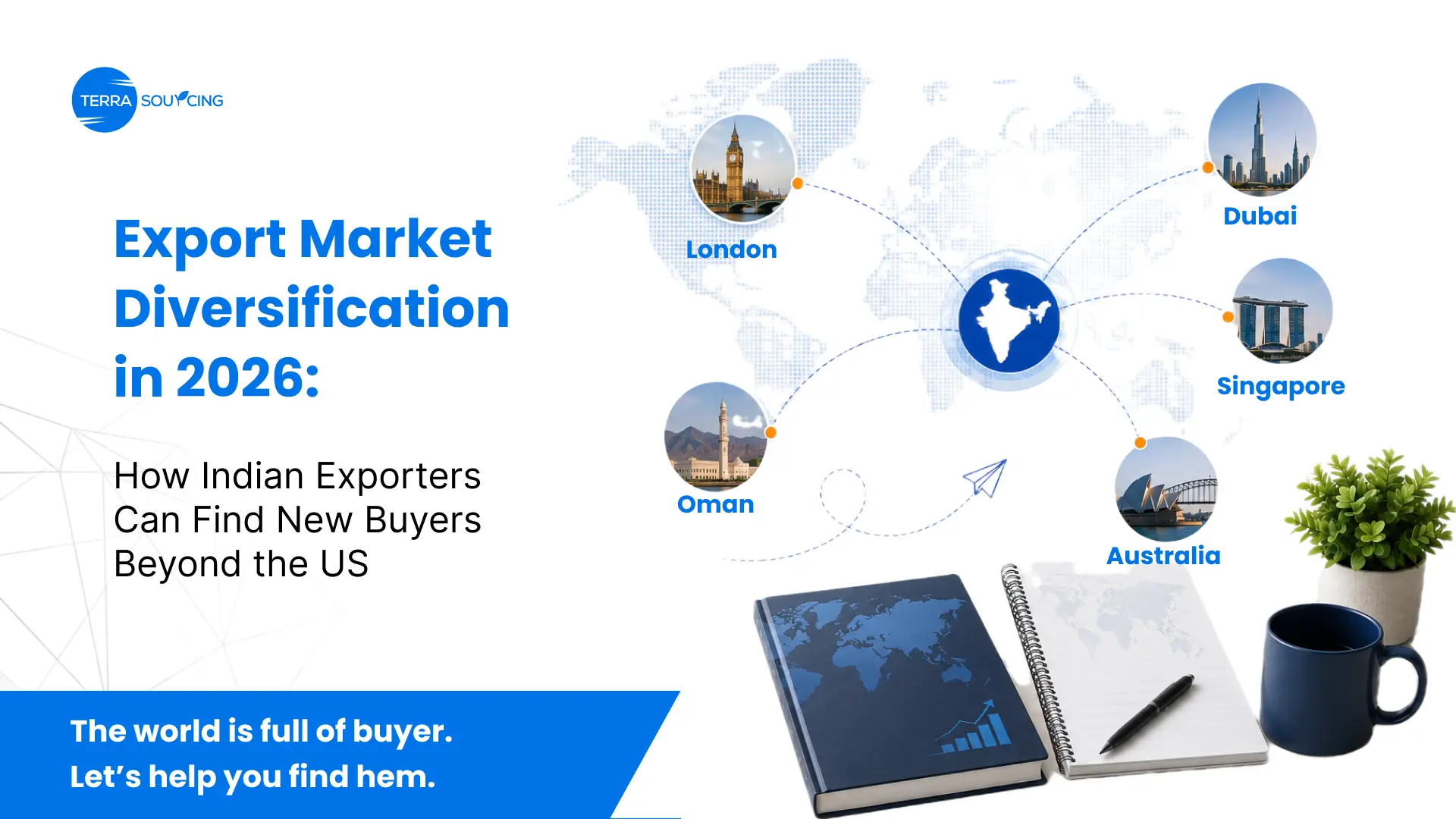
Export market diversification just means selling to buyers in more than one or two countries, so a problem in any single market can't sink your whole business. In 2026, with US tariffs eating into margins, it's the smartest move an exporter can make. And it's working — India's exports still hit a record US$863.1 billion in FY26, mostly on the back of new trade deals with markets like the UAE, ASEAN, the UK, and Oman. The exporters staying ahead are the ones who went looking for new buyers early, instead of waiting for the old market to come back.
The year a lot of exporters got a wake-up call
For years, plenty of Indian exporters ran on a simple bet: land a few solid clients in the US, keep them happy, and the business more or less runs itself. It was familiar. It was big. It felt safe.
Then 2025 happened. A fresh round of US tariffs pushed up costs, thinned out margins, and quietly turned that "safe" market into a real risk. If you were one of the exporters with most of your revenue tied to a single country, you probably felt it fast — one policy decision made on the other side of the world, and suddenly a good year turned into a nervous one.
Here's the thing, though. The exporters who came through this in good shape weren't the ones who panicked or slashed prices. They were the ones who took it as a nudge to do what solid businesses do sooner or later: stop depending on one buyer, one product, or one country. That's really what this piece is about — what diversification actually means, why everyone's talking about it this year, where the opportunities are, and how you go about finding genuine buyers in a market you've never sold to before.
So what is export market diversification, really?
Strip away the jargon and it's straightforward. Diversification is building customers across several countries so that no single market can make or break you. If one slows down — tariffs, a weak currency, a recession, a political spat — orders from the others keep the lights on.
The comparison I like is a savings portfolio. Nobody sensible puts every rupee into one stock, because one bad quarter and it's over. You spread it around so no single mistake is fatal. Exporting is the same. A business selling into eight countries can take a punch far better than one selling into a single country, even if they're doing the same revenue today.
And to be clear, this isn't about walking away from your best market. If the US still makes you money, keep it. The point is to make it one strong leg of the table instead of the only thing holding everything up.
Why everyone's talking about this in 2026
A few things landed at once.
The first is obvious — the tariffs. Selling into the US got more expensive for a lot of product categories, and the price edge Indian exporters used to enjoy shrank. When your margin in one market gets squeezed, the natural response is to go find markets where the margin is healthier.
The second is that India isn't sitting still. The country is going after roughly 40 nations for export growth and chasing something like US$200 billion in new market opportunities to cut its dependence on the US. Trade bodies have widened free trade agreements and rolled out digital platforms specifically to make these newer markets easier and cheaper to break into.
And the third — the part that actually matters — is that it's paying off. Even with the tariff drag, India's total exports hit a record US$863.1 billion in FY26, split almost down the middle between US$441.8 billion in goods and US$421.3 billion in services. This isn't a strategy people are still arguing about in webinars. It's already on the scoreboard. The exporters winning right now mostly stopped asking "how do I claw back my US margin?" and started asking a better question: "who else out there wants what I make?"
Where the opportunities actually are
India's trade agreements have quietly changed which markets are worth your time. Lower duties and lighter paperwork have turned a few regions that used to be a headache into genuine open doors. Here's where the pull is strongest this year. We have broken this down market by market in the top markets for Indian exports outside the US.
The UAE has been one of the standout stories. Under the India-UAE CEPA, the number of tariff lines covered climbed past 8,000, and the UAE landed among India's top destinations at around US$37.36 billion. It's also a launchpad into the wider Middle East and Africa, which is a bonus a lot of exporters overlook.
ASEAN was India's single biggest export region in FY26, at roughly US$38.42 billion. Vietnam, Indonesia, Malaysia, Singapore — growing middle classes, real appetite for Indian goods, everything from textiles to packaged foods to engineering products.
The UK opened up meaningfully after the India-UK deal, especially for textiles, leather, footwear, and engineering goods, with exports near US$13.44 billion. Lower duties there translate pretty directly into being able to undercut rivals on price.
Australia has been steadily easier to reach under the ECTA — hundreds of thousands of certificates of origin issued already — and it's a high-value market with serious spending power and no language barrier to worry about.
Oman is the one I'd point first-timers toward. The India-Oman CEPA kicked in on June 1, 2026, and the effect was immediate: exports jumped 189.6% year on year in the very first month. Getting into a new FTA market early usually means you grab the good relationships before everyone else piles in.
Then there's the frontier — EFTA, Africa, Latin America. Less crowded, rising demand for Indian pharma, textiles, agri products, and machinery. Plant a flag now and those relationships are yours for years.
You can see the pattern. The opportunity has moved. So the real question isn't whether to diversify anymore — it's how to actually find buyers in these places without wasting six months doing it.
How to find buyers in a new market: the part everyone gets wrong
Let me be blunt about what doesn't work: buying a giant email list and blasting a thousand strangers with the same message. It burns your time, it makes you look amateurish, and it almost never lands a deal. Finding buyers in a new country is a process. Here's the one I'd walk any exporter through, whether you're a first-time MSME or a factory that's been running for twenty years. Picking the market is half the job. The other half is finding genuine buyers once you are in that market, and verifying they are real.
Start with the data, not a hunch. Before you chase anyone, check whether there's real demand for your specific product. Look at import data, the tariff advantage you'd get under an FTA, what competitors are charging, where demand is heading for your exact HS code. I've watched exporters pour months into a market that looked great on the surface and turned out to have razor-thin margins or a local player who owned the whole segment. A proper market research report kills that guesswork early and points you at the country where the numbers genuinely work.
Then build a small, sharp buyer list, not a big one. This feels backwards to most people, but fifty genuinely relevant, verified importers will beat five thousand random contacts every single time. You want buyers who actually import your category, at volumes you can handle, in the market you picked. Getting this right is where good lead generation saves you an entire season of dead-end outreach.
Verify before you spend an hour on anyone. Unverified leads are the most expensive thing in exporting, and nobody puts it on an invoice. Every hour chasing a "buyer" who can't pay, doesn't exist, or was never really an importer is an hour stolen from a real deal, and occasionally it's worse than wasted time, it's fraud. Confirm the business is real, check the trade history, make sure the contact is legitimate. This isn't a nice-to-have. It's the whole foundation.
Write like you know their market. A buyer in Germany cares about different certifications than a buyer in Muscat. Generic templates copied across ten countries read as exactly that. Mention the local standard, the FTA benefit that applies to them, the specific reason you're worth a reply. Relevance is what turns a cold contact warm.
Use AI to move faster than you could on your own. This is the part that's genuinely changed the game. A two-person team can now do the research, shortlisting, and first-draft outreach that used to need a whole department. AI can read global demand signals, surface companies importing your product, draft market-specific messages, and rank your leads so you work the best ones first. Exporters who've learned these tools are simply quicker than the ones still doing it all by hand.
And then follow up. Then follow up again. Most export deals close on the third or fourth touch, not the first. Overseas buyers are busy and cautious, and they're usually weighing a few suppliers at once. A simple rhythm: a nudge after three days, another after a week, a check-in after two, does more than most people expect. Showing up consistently tells a buyer you'll be reliable once the orders start, which is exactly what they're trying to figure out about you.
The AI angle, without the hype
The old playbook for finding buyers — trade fairs, printed directories, someone's cousin who knows someone — still works. It's just slow, pricey, and it quietly favours whoever has the biggest travel budget. AI flattened that.
Now an exporter can figure out which companies are importing a product, where demand is climbing, and how to phrase an approach that actually resonates in that region — in an afternoon, not a quarter. Work that used to need a dedicated analyst and a sales team can be handled by a small crew who know the right tools.
That's why I keep telling exporters that AI skills have become one of the most valuable things you can build, more than most people realise. The businesses pulling ahead in 2026 aren't necessarily the biggest or the oldest. They're the ones who spot an opening first, understand the market best, and reach real buyers with the least wasted effort. AI is what makes that possible even if you're small.
The mistakes I'd tell you to avoid
A few traps catch people over and over.
Going too wide too fast is the big one. Ten markets at once usually means ten markets done badly. Pick two or three, win them properly, then expand. Depth beats breadth early on.
Skipping verification is the fastest way to lose time you'll never get back — and sometimes money too. Ignoring FTA benefits is just leaving free margin on the table; if an agreement drops your duty, use it. Treating every market the same — same pitch, same packaging, same price — signals to buyers that you haven't done this before. And giving up after one round of outreach is probably the most common reason good exporters end up with a folder full of rejections instead of deals. The ones who close are just more stubborn about following up.
If it all feels like a lot, shrink it
Don't try to boil the ocean. Over the next ninety days, pick one new market that the data says has real demand. Build a verified list of thirty to fifty genuine buyers there. Write a pitch that actually fits that market, and start reaching out consistently, tracking who replies. Watch your reply rate, tweak the message, keep following up. One market done well is worth more than five done carelessly — and once it works, you've got a template you just repeat for the next one, and the one after that.
Where TerraSourcing fits in
This is exactly the problem we built TerraSourcing to solve. We help Indian exporters find and connect with verified international buyers — through AI-powered lead generation, proper buyer verification, and market research reports that tell you where the demand actually is. So you're walking into a new market with a map, not a blindfold.
We also teach you to do it yourself. Our AI Export Course, webinars, and hands-on sessions show exporters how to use these AI tools to research markets, find buyers, and grow without adding headcount. Some clients want us to hand them verified leads; others want the skills to generate their own. We're happy either way.
Diversification is the strategy of the year. Finding the right buyers is how you actually pull it off — and that's the part we're good at. Have a look at what we do at www.terrasourcing.com.