Why Look Beyond the U.S.?
For decades, the United States has been India’s most reliable export destination. From IT services to textiles, the U.S. has grown into a multi-billion-dollar trade connection and opened global doors for Indian exporters. But recent global shifts, supply chain realignments, and policy changes remind us of one thing. No exporter can afford to put all their investment in one market considering these circumstances. That’s the reason we bring this definite guide to you. We'll explore India-U.S. trade relations, export opportunities for Indian businesses, the most profitable export products, and the top markets for Indian exports outside the U.S. So businesses like yours can discover new opportunities with confidence.
1. India and U.S. Trade Relations
India’s trade journey with the United States has been one of growth, partnership, and global impact. Over the years, both nations have deepened economic ties, creating one of the world’s strongest trade relationships. But like every partnership, it has faced challenges. Trade policies, tariff battles, and global uncertainties have often tested exporters’ resilience. For a deeper look into the forces reshaping trade like digital trade and supply chain regionalization check out our breakdown of the Top Import-Export Trends for 2025 Despite this, the U.S. still stands as India’s largest export destination, making it vital to understand how this relationship has evolved and where it stands today. The U.S. has long been one of the top markets for Indian exports, buying everything from software to textiles. Strong bilateral ties pushed India-U.S. trade past $190 billion in 2023, making America India’s single largest trading partner. Sectors like pharmaceuticals, IT services, textiles, and gems & jewelry dominate the relationship and institutions like NASSCOM and the US-India Business Council (USIBC) continue to strengthen dialogues that shape India’s global trade outlook.
2. Most Profitable Export Products from India
India’s exports are as diverse as its culture and industries, but not all products bring equal profits. Some industries stand out due to global demand for Indian products and cost competitiveness.
Understanding which sectors deliver higher margins helps exporters focus their efforts.
It’s not just about selling globally, but about targeting products that guarantee sustainability and growth.
India is a powerhouse of diverse industries and exports. Some industries consistently deliver high margins and global demand.
| ● | Pharmaceuticals: India supplies affordable yet high-quality medicines to over 200 countries. Rising healthcare costs worldwide ensure steady demand and profits. |
|---|---|
| ● | IT Services: Software and tech exports bring billions, driven by U.S. and European demand. India’s skilled workforce adds unmatched value. |
| ● | Textiles & Apparel: Indian cotton, silk, and ready-made garments are loved across the globe, ensuring strong repeat orders. These products remain in high demand products from India |
| ● | Gems & Jewelry: With design expertise and global trust, India remains a leader in polished diamonds and ornaments. |
| ● | Agro Products: Rice, spices, and tea continue to dominate demand across Asia, the Middle East, and Africa. |
But profitability alone isn’t enough.
Exporters must also navigate real-world problems. That’s where our definite guide on challenges faced by exporters in India come in. which breaks down issues like documentation, market access, financing, and infrastructure in clear, actionable terms.
3. Which Countries Are Best for Exports from India?
Every exporter dreams of finding the right destination for their products. While the U.S. has been dominant, new emerging export markets for India are gaining traction.
The key lies in identifying where demand matches supply.
Factors like tariffs, consumer preferences, and bilateral ties determine which country is truly the best for Indian exports today.
It depends on the product, but some destinations stand out for long-term opportunities. The answer differs by product. A market research report tells you which countries are buying your specific HS code, at what price and in what volume.
| ● | UAE: With its strategic location and strong cultural ties, the UAE gives Indian exporters access to both Middle Eastern and African markets. Profits lie not just in re-exports but also in the UAE’s own demand for food, jewelry, and textiles. |
|---|---|
| ● | UK: Despite Brexit challenges, the UK remains profitable due to the Indian community living in the UK and demand for textiles, IT, and food products. Stable bilateral ties keep the market strong. |
| ● | “Brexit” means the UK’s exit from the European Union. It was driven by the desire for more control over trade, immigration, and laws. |
While it created challenges like new trade barriers, higher costs, and market uncertainty, it also gave the UK freedom to build stronger ties with non-European Union countries.
For India, this shift has opened fresh opportunities.
Backed by strong overseas Indian community links and historic trade relations, the UK continues to be a resilient and profitable export market.Germany: As Europe’s largest economy, Germany values Indian engineering goods, chemicals, and IT services. Long-term demand is backed by industrial strength.
| ● | Australia: Growing Indian community in Australia, plus high demand for pharmaceuticals and textiles, makes Australia an emerging market for exporters. |
|---|
This shows how diversification of Indian exports reduces risk and unlocks long-term growth.
4. Which Country Imports the Most from India?
While exporters are always searching for new opportunities, it’s equally important to know which countries already import heavily from India.
This helps exporters understand where India’s strongest trade relationships lie.
By knowing the top buyers, businesses can strengthen their presence in those regions. At the same time, it gives exporters insights into which markets are still growing and which ones are stabilizing.
| ● | UAE: A trade powerhouse for India. According to India Brand Equity Foundation (IBEF) the UAE recorded exports worth $35.6 billion in 2023-24, making it India’s second-largest export destination and third-largest trading partner. |
|---|---|
| ● | Key imports include gems & jewellery, petroleum products, machinery, and electronicsChina: Despite political tensions, India supplies iron ore, cotton, and chemicals in huge volumes. |
| ● | As both nations discuss reopening border crossings to revive India and China’s border trade. It opens new routes for import and export and signals that in the future there will be countless opportunities to grow.Bangladesh: Proximity and cultural ties make it a consistent buyer from India. |
According to India Briefing, which often relies on data from the Directorate General of Commercial Intelligence and Statistics (DGCIS) under the Ministry of Commerce, Government of India, Bangladesh holds a critical position in India’s export landscape.
Why is this important?
Because Bangladesh alone accounts for more than 50% of India’s raw cotton exports. Not just that—Bangladesh is also a leading buyer of oilmeals and spices, strengthening its role as a top trade partner.
And here’s something even more striking: manufactured goods such as textiles and engineering products make up 55% of India’s exports to Bangladesh.
5. India’s Export-Import Data
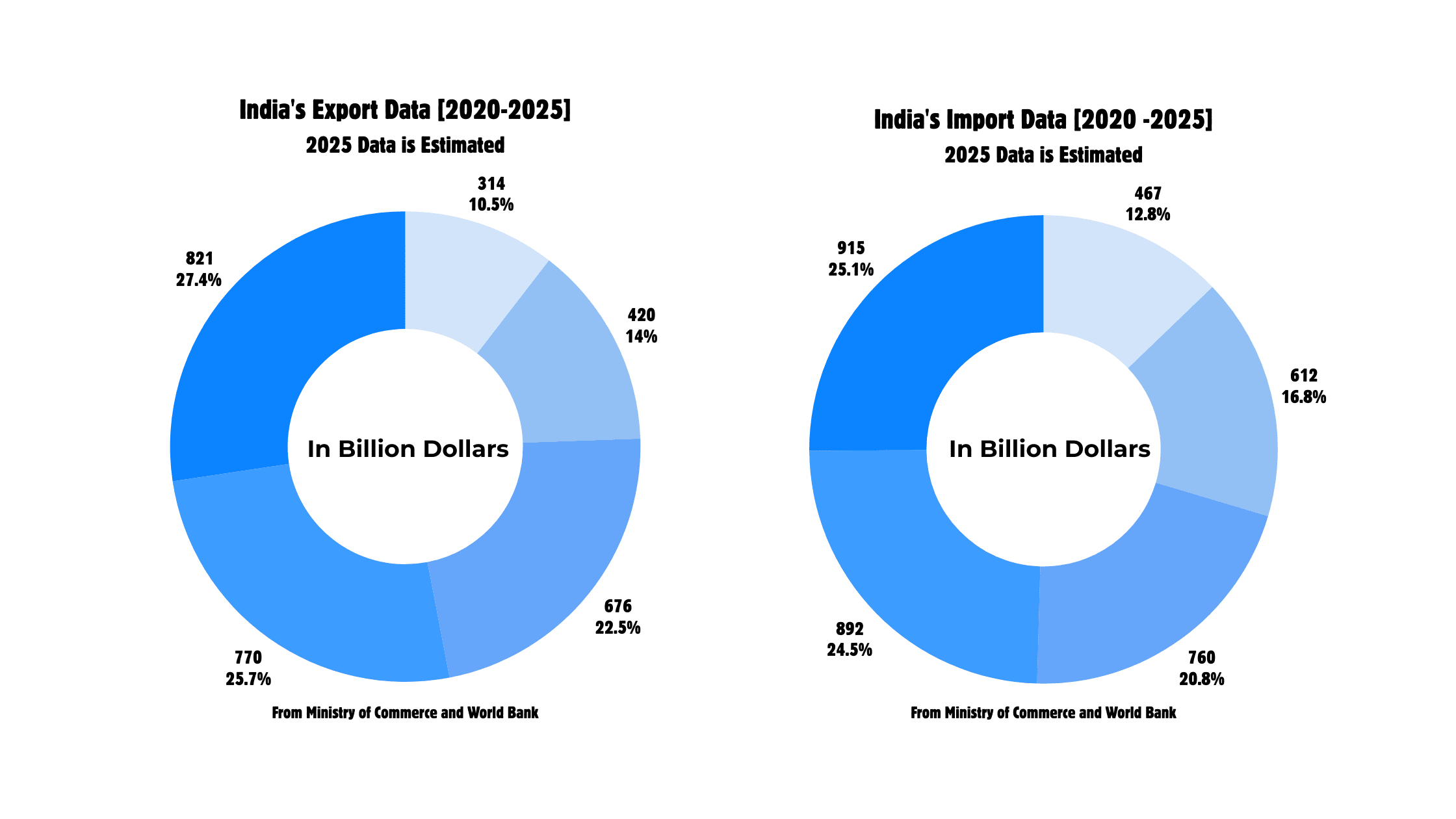
Trade numbers reveal how India’s merchandise vs. services exports have evolved and how exporters have adapted to new opportunities. From 2020–21 to 2024–25, India’s exports raised sharply from around $314 billion in 2020–21 to a projected $821 billion in 2024–25. Imports, however, have consistently remained higher, crossing $900 billion in 2024–25, which shows that India still buys more than it sells globally. Here’s a quick snapshot of the numbers:
| Year | Exports (Merchandise + Services) | ||
|---|---|---|---|
| in billion dollars | Imports (Merchandise + Services) | ||
| in billion dollars | Trade Balance | ||
| 2020–21 | US$ 314 | US$ 467 | -153 |
| 2021–22 | US$ 420 | US$ 612 | -192 |
| 2022–23 | US$ 676 | US$ 760 | -84 |
| 2023–24 | US$ 770 | US$ 892 | -122 |
| 2024–25 | US$ 821 | US$ 915 | -94 |
2025 figures are provisional estimates.
What does this mean?
It highlights both opportunities and gaps in India’s export competitiveness. On one hand, rising exports show growth potential. On the other, higher imports mean India must strengthen export strategies for Indian businesses to balance trade. These figures come from trusted sources like the Ministry of Commerce, the World Bank, and Macrotrends. In fact, the Government of India regularly releases official trade updates, which makes this data both authentic and reliable. They guide smart decisions. To make sense of such data, our Market Research Report for export business helps exporters identify demand, pricing, and growth markets systematically
6. Top Markets for Indian Exports Outside the U.S.
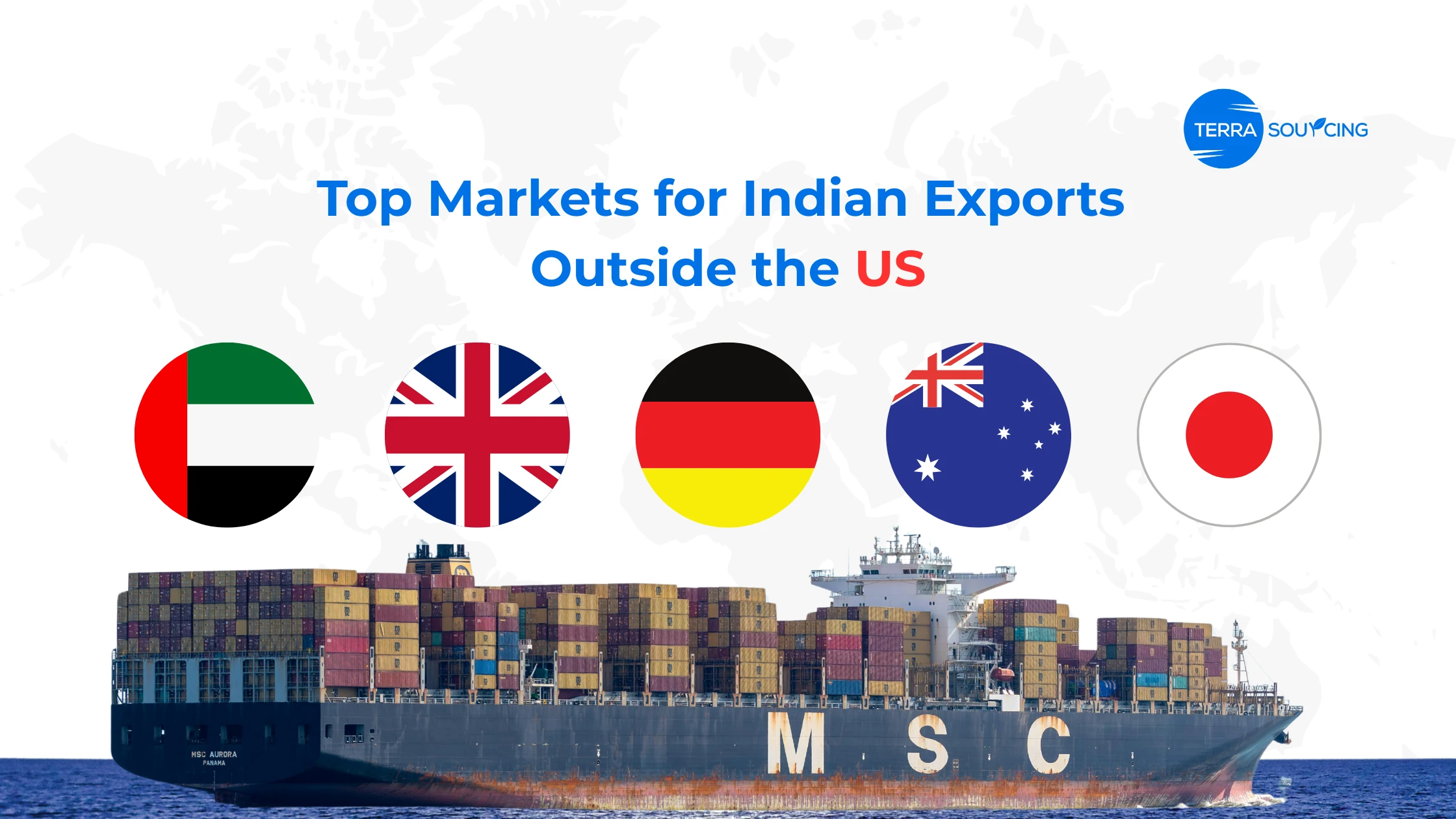
Exporters relying on one country risk losing opportunities during global shifts. That’s why exploring new markets beyond the U.S. and connecting with verified buyers is no longer optional. It’s a necessity. The world is full of strong, high-demand destinations for Indian products. From the Middle East to Africa, from Europe to Southeast Asia, Indian exporters can tap new opportunities and expand globally with confidence. Looking at the future, India’s trade with developing countries will define the future of Indian exports.
Key regions include:
- United Arab Emirates (UAE)
| ● | The UAE is not just one of India’s biggest trading partners but also a gateway to the Middle East and Africa. Indian products like gems, jewelry, textiles, and food items enjoy strong demand here. |
|---|---|
| ● | Why UAE? |
Its strategic location, efficient logistics, and cultural closeness with India give exporters a powerful edge.
- United Kingdom (UK)
| ● | Even after Brexit, the UK remains a trusted market for Indian goods. Pharmaceuticals, IT services, textiles, and auto components continue to drive exports here. |
|---|---|
| ● | Why UK? |
A thriving Indian diaspora, long-standing trade ties, and a preference for quality Indian products keep the UK a vital partner.
- Germany
| ● | Germany, Europe’s largest economy, offers a steady and high-value market for Indian exports. Engineering goods, chemicals, textiles, and organic food products top the list. |
|---|---|
| ● | Why Germany? |
The country’s focus on precision, green technologies, and sustainable sourcing opens opportunities for Indian exporters.
- Australia
| ● | Australia and India have deepened trade links, especially through the India-Australia Economic Cooperation and Trade Agreement (ECTA). This has boosted exports of agriculture, textiles, and pharmaceuticals. |
|---|---|
| ● | Why Australia? |
Lower tariffs under ECTA, proximity to Asian markets, and a rising appetite for Indian agri-products make it profitable.
- Japan
| ● | Japan values high-quality products over bulk, making it a premium destination for Indian exports like auto parts, electronics, seafood, and organics. |
|---|---|
| ● | Why Japan? |
As a stable trade ally, Japan is increasingly turning to India for manufacturing partnerships and supply chain reliability.
- African Markets (Kenya, South Africa, Nigeria)
| ● | Africa is one of the fastest-growing export destinations for India, with pharmaceuticals, textiles, and machinery leading the way. The growing middle class is fueling consumption. |
|---|---|
| ● | Why Africa? |
Rapid infrastructure growth, stronger India-Africa partnerships, and untapped consumer potential make it a rising star for exporters.
- Southeast Asia (Singapore, Vietnam, Indonesia, Malaysia)
| ● | Southeast Asia has become a crucial hub for Indian exports, driven by electronics, plastics, engineering goods, and processed foods. |
|---|---|
| ● | Why SEA? |
Free Trade Agreements, proximity to India, and booming consumer demand make it a natural choice for diversification.
Why Diversification Matters for Exporters
| ● | It reduces dependency on a single country. |
|---|---|
| ● | It protects businesses from economic or policy shocks like tariffs or sanctions. |
| ● | It opens doors to new consumer bases and industries. |
| ● | It builds long-term stability and resilience for exporters. |
7. Key Factors Shaping India’s Exports in New Markets
Finding new markets is one thing, but succeeding in them is another. Exporters need to understand the driving forces that shape global trade and adapt accordingly.
From government trade agreements to logistics, from cultural differences to economic shifts. Every factor plays a role in deciding whether an export strategy succeeds or fails.
| ● | Trade Agreements:India’s bilateral trade agreements like ECTA (Australia) and CEPA (UAE) reduce tariffs. Deals with UAE, Australia, and ASEAN nations are opening fresh doors. |
|---|---|
| ● | Logistics & Connectivity:Efficient shipping and air routes lower costs and improve India’s export competitiveness. Ports like Mundra and JNPT are key enablers. |
| ● | Cultural Compatibility:Products perform better in markets with cultural similarities. Indian food and textiles thrive in the UK and Middle East. |
| ● | Economic Growth in Target Markets:Rising middle classes in Africa and Southeast Asia boosts India’s trade with developing countries. |
Looking Beyond Borders
The future of Indian exports will not be defined by one country but by a diversified network of markets. The U.S. will always remain important, but exporters who embrace export opportunities for Indian businesses, diversify wisely, and adapt to export growth trends 2025 will thrive. By leveraging India’s global trade outlook, aligning with global demand for Indian products, and building strong export strategies for Indian businesses, exporters can reduce risks and secure long-term growth. The world is opening new doors and those who look beyond the U.S. market today will define India’s trade story tomorrow.