Most exporters do not have an outreach problem. They have a follow-up problem. One email goes out, nothing comes back, and the buyer is quietly written off as uninterested. In reality that buyer opened the message between two other tasks, meant to come back to it, and never did.
Knowing how to approach foreign buyers for export is less about finding the perfect first sentence and more about running a sequence: a small number of well-spaced touches across email, LinkedIn and WhatsApp, each adding something the buyer did not have before, tracked so nothing is forgotten. This article gives you that system: the prerequisites, a 14-day, five-touch cadence day by day, the rules for each channel, what to do with every kind of reply, the tracker fields, and the weekly rhythm that keeps it running. The email copy itself lives in our seven export email templates, so this playbook links rather than repeats.
What is an export outreach sequence?
An export outreach sequence is a planned series of contacts with one buyer across more than one channel, spaced over a fixed period, where every touch adds new information and ends with one easy next step. A workable standard is five touches over 14 days: two or three emails, one LinkedIn approach, and one WhatsApp message where the buyer publishes a business number, followed by a closing note. The sequence exists so that follow-up happens by design rather than by memory.
Two things make a sequence different from "sending emails". Every touch has a job, so you never send "just following up". And the sequence has an end, so a buyer either enters your pipeline, tells you no, or moves to a re-engagement list ninety days out. Nobody sits in limbo, and you never chase the same contact for months.
Why does single-channel outreach fail?
Because one message on one channel depends on a busy stranger being available at the exact moment it arrives. Buyers are travelling, in meetings, or triaging a full inbox. A single email that goes unanswered proves nothing about interest. It usually proves timing.
The other failures are just as ordinary:
- No follow-up. The most common reason an exporter gets no replies is that they sent one message. Replies frequently arrive on the second or third touch, from people who were genuinely interested the first time.
- Follow-ups that add nothing. "Gentle reminder" and "awaiting your kind reply" give the buyer no new reason to respond and a small reason to be annoyed.
- Wrong channel for the market. Some buyers live in email, some answer LinkedIn within an hour, and in parts of the Gulf, Africa and South East Asia a business WhatsApp message is normal and welcome. One channel means one chance.
- No record. Without a tracker, the fourth touch never happens, the same buyer gets contacted twice by two people, and nobody knows which markets responded.
Before you start: three prerequisites
Do not run this system on a bad list or an invisible company. Fix these first and everything downstream gets easier.
- Verified buyers only. A sequence multiplies whatever quality your list has. Run the four-level check on each contact, or send us ten leads and have them verified free before you commit two weeks of touches to them.
- A presence that survives being checked. Buyers look you up between your touches. If your website, LinkedIn and contact details do not answer their questions, the sequence is spending attention you cannot convert. Our article on what importers look for in a supplier lists the five checks they run, and the free marketing audit scores you against them.
- A product block you can paste. Product and grade, key specification, packing options, MOQ, lead time, certifications, price basis, port. Write it once. Every touch below draws from it.
The 5-touch sequence over 14 days
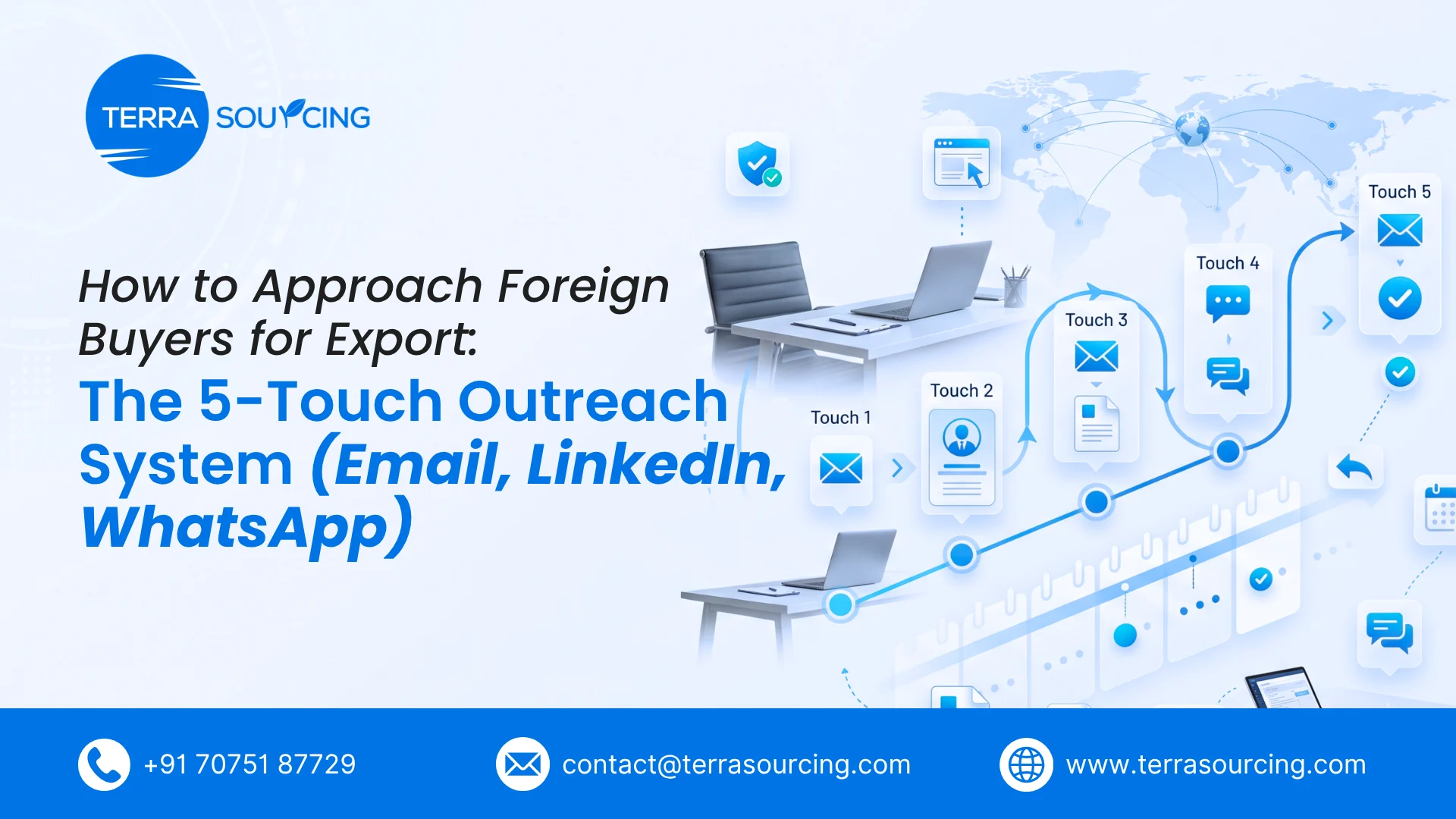
Touch 1 (day 0): the first email. Touch 2 (day 2): LinkedIn connection with a short note. Touch 3 (day 4): the second email with the specification sheet. Touch 4 (day 8): WhatsApp if the buyer publishes a business number, otherwise a LinkedIn message. Touch 5 (day 12 to 14): the closing note. Each touch adds new information, and the sequence ends cleanly whether or not the buyer replies.
| Touch | Day | Channel | Job of this touch | What it contains |
|---|---|---|---|---|
| 1 | 0 | Establish relevance and make one easy ask | Why this buyer, product block, one offer, one question | |
| 2 | 2 | Put a face to the email; open a second door | Connection request with a short, non-selling note | |
| 3 | 4 | Add value and make it easy to say no | Specification sheet, one market-specific detail, permission line | |
| 4 | 8 | WhatsApp or LinkedIn message | Reach the buyer where they actually respond | Two lines, referencing the email, one question |
| 5 | 12 to 14 | Close the loop and ask for a referral | Closing note, contact block, request for the right person |
Touch 1, day 0: the first email
The opening message names one product with real specifications, states in one line why this buyer received it, offers one concrete thing (the specification sheet or a sample quotation) and asks one question that can be answered with a yes. Keep it to 120 to 160 words, send it from your business domain, and use Template 1 from our email templates rather than writing from scratch.
Send so the email lands in the buyer's morning. For most Gulf markets that means sending early in the Indian morning; for Europe, mid-morning India time; for the Americas, evening India time. Landing at the top of the working day is worth more than any subject line trick.
Touch 2, day 2: the LinkedIn connection
Two days later, send a connection request with a short note that does not sell. Something like: you supply the category their company imports, you wrote to them on Monday, and you would value being connected. That is all. The purpose is recognition: when your second email arrives, your name is no longer unfamiliar, and the buyer can see a real person with a real company behind the message.
Two rules keep this channel healthy. Do not pitch in a connection note, and do not send a long message immediately after they accept. Our LinkedIn playbook for exporters covers profile setup and message structure in depth.
Touch 3, day 4: the second email
This is the touch most exporters skip, and it is usually where replies start. A follow up email to a foreign buyer must add something: the specification sheet as an attachment under 2 MB, one detail relevant to their market (a packing or labelling requirement, a certification they will care about), and a permission line that makes it easy to say no. Template 3 in our email pack is written for exactly this.
The permission line matters more than it looks: "if this is not something you are sourcing at present, tell me and I will not follow up further" converts silence into a clear answer, and a clear no is worth far more than an open loop.
Touch 4, day 8: WhatsApp, carefully
In much of the Gulf, Africa, South East Asia and parts of Latin America, business is done on WhatsApp, and a short professional message is normal. In much of Europe and North America it is not, and it will read as intrusive. So the rule is narrow: message only the number a company publishes as a business contact, only during their business hours, only once, and only referencing your earlier email.
Two lines is the whole message: who you are and what you sent, plus one easy question. Use WhatsApp Business so your profile shows your company name, website and catalogue, and never send a voice note, a PDF or a photograph in a first message. If the buyer does not publish a business number, do not hunt for a personal one; send a short LinkedIn message instead.
Touch 5, day 12 to 14: the closing note
The last touch says it is the last one. It states that you have written twice, assumes this is not a priority right now, leaves your details, and asks one final question: if someone else at the company handles this category, would they point you to them. Template 4 in the email pack is written for this.
This message produces two valuable outcomes disproportionately often: a reply from someone who had genuinely meant to answer, and a referral to the correct person, which is the single most useful thing an outreach sequence can produce after an actual order.
Channel rules that keep you welcome
| Channel | Use it for | Never |
|---|---|---|
| The substance: specifications, quotations, documents, anything the buyer must forward internally | Blast the same text to a bought list; attach heavy files; send more than three times without a reply | |
| Recognition, finding the right person, light touches, sharing proof of activity | Pitch in the connection note; send paragraphs after acceptance; connect and immediately ask for an order | |
| Short confirmations and quick questions, in markets where it is normal, on published business numbers | Message a personal number; send at night in their time zone; send voice notes, catalogues or repeated follow-ups | |
| Phone | Confirming a meeting, a call the buyer has agreed to, and call-backs during verification | Cold-call before any written contact, unless the market genuinely expects it |
The underlying principle is simple: every channel is borrowed. The moment you use it in a way that annoys buyers, you lose it for every future prospect, and in the case of email you can lose deliverability for your whole domain.
What to do when a buyer replies
Route every reply the same day into one of five outcomes: interested, later, wrong person, information request, or no. Each has a different next step, and each ends with the tracker updated. The mistake is treating every reply as a sale and answering only the enthusiastic ones.
| Reply type | What it sounds like | Your next step |
|---|---|---|
| Interested | "Send your best price for X quantity" | Ask the two questions you need to quote accurately, then send the quotation email with terms in the body; complete verification before samples |
| Later | "Not buying now, maybe next season" | Thank them, ask when to come back, set a reminder for that date, and move them to nurture |
| Wrong person | "Purchasing is handled by my colleague" | Ask for an introduction by name, then start a fresh sequence with the correct contact |
| Information request | "What certifications do you have?" | Answer precisely and completely the same day, then ask your next-step question |
| No | "We have a supplier" or "not interested" | Thank them, ask one question about what would make a future conversation useful, move to re-engagement in 90 days |
Two habits matter here. Reply within one working day, with content rather than acknowledgement. And treat a clear no as a success: it costs you nothing and it frees the slot for a buyer who might say yes. When a reply does turn into a meeting, our guide to preparing for your first buyer meeting covers what buyers ask.
The tracker: what to record and why
A sequence you cannot see is a sequence that stops after touch two. One sheet is enough, and it should have exactly these columns:
| Field | Why it is there |
|---|---|
| Company, country, contact name, role | Basic identity |
| Verified (yes/no) and date verified | Nothing enters the sequence unverified |
| Source (trade data, fair, portal, referral) | Tells you which sources produce replies |
| Product and target market | Lets you spot which product-market pairs work |
| Touch 1 to 5: date sent, channel, what was sent | Makes follow-up happen and prevents duplicates |
| Reply date and type | Feeds the routing table above |
| Stage (sequenced, replied, quoting, meeting, order, closed, nurture) | Shows the shape of the pipeline |
| Next action and next action date | The single most important column in the sheet |
| Notes | Anything a colleague would need to take over |
Two rules. Every buyer in the sheet must have a next action and a date, or they are not in the pipeline. And update the sheet at the moment of the touch, not at the end of the week, because retrospective entry is how buyers get lost. Our post on building a buyer pipeline tracker gives the spreadsheet version with formulas.
The weekly rhythm
An export follow up system fails from irregularity more than from bad copy. A simple weekly cadence keeps it alive:
- 4. Monday, 30 minutes. Review the tracker. Which touches are due this week? Which buyers replied and have no next action? Which have gone stale?
- Monday to Thursday. Send the day's touches in one block, ideally at the time that lands in the buyer's morning. Add new verified buyers to the top of the sequence in batches.
- Every day. Answer replies within one working day.
- Friday, 15 minutes. Log what you learned: subject lines that got opened, markets that answered, objections that repeated. Adjust next week's copy accordingly.
Batch size matters. Twenty to thirty new buyers entering the sequence per week is a realistic load for one person, because each of them generates four more touches over the following fortnight. Adding a hundred at once guarantees that touches three, four and five never happen, which is the same as sending one email to a hundred people.
Personalising at speed without sounding automated
Personalisation is not the buyer's first name. It is the one line that proves you looked: the category they import, a product on their website, the market they serve, the fair they exhibited at. One such line per buyer is enough.
To do this at speed, keep your product block ready and use AI to adapt rather than to invent. Paste the buyer's website text and ask for the three specific things worth referencing, then write the line yourself. The prompts for this are in our 25 AI prompts for exporters, with the same rule that applies everywhere: the model adapts and shortens, you supply every fact.
On language, a short version in the buyer's business language above the English text helps in the Gulf, francophone Africa, Latin America and parts of Europe. Have it checked once by a fluent speaker, because a template error repeats with every send.
When to stop, and when to come back
The sequence ends at touch five. After that:
- No reply at all: move to a re-engagement list and contact again in about 90 days, with genuine news (a new certification, a new packing size, a new capacity). Template 7 in our email pack is written for this.
- A clear no: re-engage only if something material changes on your side or theirs.
- A "later": contact on the date they named, not before, and reference their own words when you do.
- Bounced or invalid: remove the contact and check the rest of that batch, because a bad address often means a stale source.
Stopping cleanly is what makes the next attempt welcome. Exporters who chase indefinitely get marked as spam; exporters who close politely get answered a season later.
What to measure (and what not to)
Track four things: touches completed as a percentage of touches planned, replies by type, meetings booked, and quotations sent. The first one is the leading indicator, and it is the one exporters ignore. If you planned 150 touches this month and completed 60, no change to your subject lines will fix the result.
Two cautions. Do not chase industry benchmark reply rates you read online; your product, market and list quality determine yours, and only your own numbers over a few months are meaningful. And do not judge a sequence on one batch of twenty buyers; the sample is too small to tell you anything except whether you executed.
How this works inside the consultation
If running this yourself sounds like the right method but not the right use of your week, this is exactly what Month 2 of the consultation does: we build the sequence with your product block, write the touches in the buyer's language, load the tracker, run the campaign alongside you and review replies on a weekly 30-minute call, after Month 1 has fixed your presence and produced verified buyers to sequence. You keep the tracker, the templates and the method at the end. If that fits, apply for consultation and we will start with a 15-minute call.
Mistakes to avoid
- Sending touch one to a list you have not verified.
- Skipping touch three, which is where many replies begin.
- Writing "gentle reminder" instead of adding new information.
- Messaging a personal WhatsApp number, or messaging at night in the buyer's time zone.
- Pitching inside a LinkedIn connection note.
- Adding a hundred buyers in one week and completing five touches.
- Leaving replies for two or three days.
- Keeping the sequence going for months instead of closing and re-engaging at 90 days.
How to approach foreign buyers for export comes down to a system rather than a script: verified buyers, a presence that survives inspection, five well-spaced touches across email, LinkedIn and WhatsApp, every touch adding something, every reply routed the same day, and every buyer carrying a next action with a date. Run twenty to thirty new buyers a week through that, review it for thirty minutes each Monday, and outreach stops being an occasional burst of effort and starts producing conversations.
Start by making sure the list deserves the effort: send us 10 buyer leads and we will verify them free. If you would rather have the sequence built and run with you, apply for consultation and we will set it up in Month 2 with a weekly call until buyers reply.