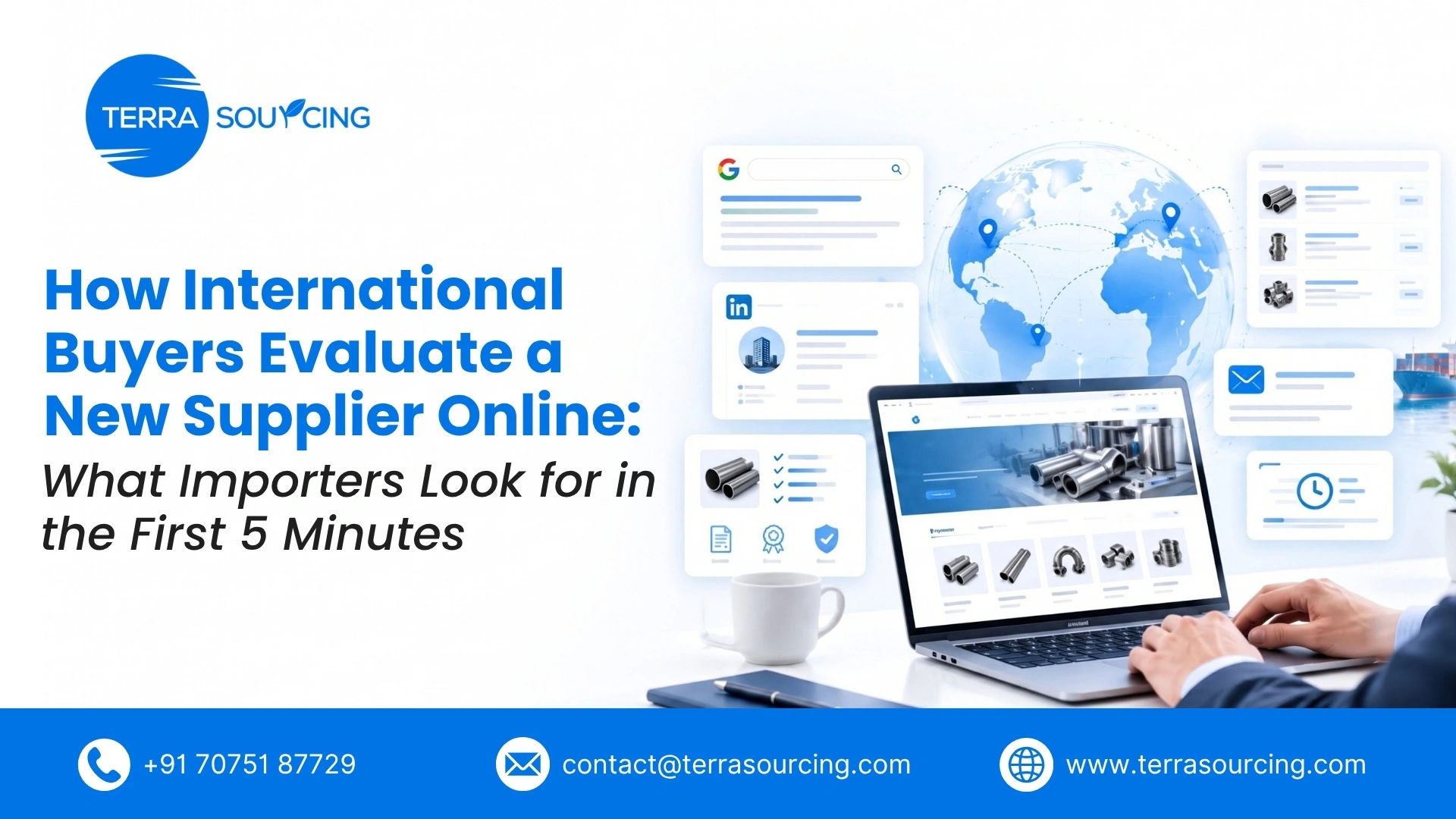
Exporters who read our guide on how to verify a foreign buyer sometimes ask a fair question: do buyers do this to us too? They do. Before an importer replies to your email, opens your catalogue or returns your call, someone on their side spends a few minutes checking you online. They do not send you the result. If you fail, the only signal you receive is silence.
That silence is why this article exists. It walks through what importers look for in a supplier during that first check: the five things they look at, in the order they usually look, what a pass and a fail look like for each, and how to fix the gaps this week. The checks take a buyer about five minutes. Passing them is the cheapest improvement most exporters can make to their reply rate, because it upgrades every inquiry, every outreach message and every trade-fair follow-up at once.
What do importers look for in a supplier?
Before replying, importers look for evidence that a new supplier is real, capable and safe to deal with: a findable company (a clean Google result), a website that answers product, specification, MOQ and certification questions, real people visible on LinkedIn, consistent listings and catalogue details across platforms, and professional contact details on the company's own domain, answered quickly. Price matters later. In the first five minutes, the buyer is pricing risk, not product.
Understand that last line and the rest follows. An importer who chooses a bad supplier loses money, time and sometimes a customer of their own. So their first pass over you is defensive: is this exporter going to embarrass me? Every check below is a proxy for that one question. This is the mirror image of your own buyer checks. If you are still working on finding genuine buyers for export from India, read that first.
Why do buyers check exporters before replying?
Because the buyer carries the downstream risk. An importer who pays an advance to a weak supplier, or builds a launch on a shipment that arrives late, wrong or not at all, pays for it with their own customers. Supplier evaluation by importers is the same instinct as buyer verification by exporters: confirm the counterparty is real and competent before spending time or money. The difference is that buyers rarely tell you they checked, and never tell you why you failed.
Three things follow from this:
- Silence is data. If genuine buyers open your messages and do not reply, the problem is often not demand or price. It is what they found, or failed to find, when they looked you up.
- The check is cheap for them and decisive for you. Five minutes of their time can end months of your effort. That asymmetry is why buyer readiness belongs ahead of more outreach, more portal credits or more samples.
- You can pass on purpose. The checks are predictable. That is good news: predictable tests can be prepared for.
The 5-minute check, minute by minute
A typical first evaluation runs in this order: a Google search of your company name (about a minute), your website (about two minutes), LinkedIn (about a minute), a quick consistency check of your listings and catalogue (about a minute), and a look at your contact details, followed by how fast and how well you reply. Fail early and the later checks never happen.
| Minutes | What the buyer does | What they are deciding |
|---|---|---|
| 0 to 1 | Searches your exact company name on Google | Does this company exist beyond the message I received? |
| 1 to 3 | Opens your website; looks for products, specifications, MOQ, certifications, address | Can this supplier actually make and ship what I need? |
| 3 to 4 | Checks LinkedIn for the company and the founder or sales contact | Are there real, accountable people behind this? |
| 4 to 5 | Skims your portal listings, catalogue and Google Business Profile for consistency | Do the details match everywhere, or is something off? |
| After 5 | Waits for your reply; judges its speed, language and precision | Will this supplier be reliable to work with day to day? |
The rest of this article takes the five checks one at a time. As you read, score yourself honestly; there is a scoring table at the end.
Check 1: The Google search (the first 60 seconds)
The buyer types your exact company name, sometimes with your product or city. This is how buyers evaluate exporters before anything else, because it costs them nothing.
What a pass looks like. Your website is on the first page. Your Google Business Profile appears with a consistent name, address and phone. A LinkedIn page, a portal listing or two, maybe a trade-fair mention or an export promotion council directory entry. Nothing alarming.
What a fail looks like. Nothing at all, so you exist only inside their inbox. Or a mess: three different companies with similar names and no way to tell which is you. Or worse, complaint threads and scam warnings above your own site.
Fix it. Claim and complete your Google Business Profile with the same name, address and phone you use everywhere. Make sure your website's title tag carries your company name. If your name is generic or shared, add your city or product to your public profiles so the right company is unmistakable. Search your own name monthly; if something negative appears, address it rather than hoping buyers will not see it.
Check 2: Your website (the two minutes that decide most replies)
This is the heaviest check, and the one where Indian exporters lose the most replies. Many exporter websites are built for Indian customers, or for nobody in particular: a slider, some stock photography, "we deal in all kinds of products", and a WhatsApp number.
What the buyer needs to find in two minutes:
- What exactly you make or supply, with real product names, grades and photographs of your actual product, not stock images.
- Specifications a buyer can act on: sizes, grades, packing options, HS code if you are comfortable publishing it, shelf life where relevant.
- MOQ and supply capacity, even as a range. Buyers shortlist suppliers whose scale fits their order.
- Certifications and registrations that matter in their market, stated plainly, with the certificate available on request.
- Who and where you are: a real address, a named founder or sales lead, your IEC or GST context if you choose, and an email on your own domain.
- English that reads cleanly, because for most buyers your website is a sample of how working with you will feel.
What a fail looks like. No specifications, no MOQ, no address; "contact us for details" behind every question; a site that is slow or broken on mobile; an inquiry form that goes nowhere. Any one of these can end the evaluation, because the buyer's conclusion is not "I will ask". It is "this will be hard work", and they move to the next supplier.
Fix it. You do not need a big site. One well-built page that answers the six points above outperforms a ten-page brochure site. Our export website checklist covers this in detail, and a one-page export landing page is one of the first assets built in Month 1 of the consultation.
Check 3: LinkedIn (the people behind the company)
B2B buyers buy from people. After the website, many check LinkedIn for the company and for the person who contacted them.
What a pass looks like. A company page with your logo, a clear one-line description, your products and your location. A founder or sales-lead profile that names the company, shows some activity, and matches the person signing the emails. The contact who emailed the buyer actually exists and works where they say they work.
What a fail looks like. No company page. A contact person who cannot be found, or whose profile names a different company. A profile created last week with no connections. Buyers read our verification guide in reverse here: the same identity checks exporters run on buyers, buyers run on you.
Fix it. Create the company page in an afternoon. Update the founder's profile: photograph, role, company link, one line about what you export and to where. Post occasionally: a shipment, a certification, a fair you attended. Activity is credibility; it shows the company is alive this month, not just registered once.
Check 4: Listings, catalogue and consistency (the detail check)
Buyers rarely study your IndiaMART or Alibaba listing in depth. What they do notice, quickly, is whether your details agree with each other.
What a pass looks like. The company name, address, phone and product range on your portal listings match your website and your Google Business Profile. Your catalogue PDF, if you send one, carries the same branding, the same contact details and the same specifications as your site. Prices, where shown, do not contradict each other.
What a fail looks like. Three different phone numbers across three platforms. A listing that says "manufacturer" while the website says "trader". A catalogue with another company's name in the file properties, or specifications that disagree with the website. None of these proves anything is wrong, but each one raises the buyer's risk estimate, and risk is the whole evaluation.
Fix it. Pick one canonical set of details: legal name, address, one phone, one email on your domain. Update every listing, profile and document to match. Retire old numbers and dead listings. This is an afternoon of work that quietly upgrades every channel you use.
Check 5: Contact details and your first reply
The last check spans the five-minute mark: the buyer looks at how you can be reached, then finds out how you respond.
What a pass looks like. An email on your own domain (yourname@yourcompany.com), a phone that is answered during business hours, and a reply within one working day that answers the buyer's actual questions: specification, MOQ, packing, port, indicative terms. The reply is specific, in clean English, from the same named person the buyer can find on LinkedIn.
What a fail looks like. Only a free webmail address and a WhatsApp number. A reply that takes four days. A reply that ignores the questions and pastes a brochure. Pressure for a call before any information is shared. Buyers treat a free email address on a company that claims scale exactly the way you should treat it on a buyer: a flag to resolve. Some will ask; most will simply not reply.
Fix it. Business email on your own domain costs little and takes an hour to set up. Decide who owns inquiry replies and give them a one-working-day standard. Build a short reply template that answers the five questions every serious buyer asks, and pair it with a follow-up sequence so one unanswered message does not end the conversation.
Score yourself: the 10-point buyer-readiness check
Score each check honestly: 2 if you clearly pass, 1 if partly, 0 if you fail. This mirrors the scored report our Free Marketing Audit returns, so you can run the self-test now and the full audit when a slot opens.
| Check | 0 points | 1 point | 2 points |
|---|---|---|---|
| Google search | Nothing findable, or confusing/negative results | Findable but thin or inconsistent | Clean first page: site, profile, consistent details |
| Website | No site, or no specs/MOQ/address | Site exists but leaves key questions unanswered | One page or more that answers product, specs, MOQ, certifications, who/where |
| No company page; contact unfindable | Page exists but empty or inactive | Company page plus an active, matching founder/sales profile | |
| Consistency | Details contradict across platforms | Mostly consistent, some stale listings | One canonical name, address, phone, email everywhere |
| Contact and reply | Webmail only; replies take days | Domain email or fast replies, not both | Domain email, one-working-day replies that answer the questions |
8 to 10: buyer-ready. Your presence is not what is costing you replies; put your effort into targeting and outreach. 4 to 7: you are losing replies you never see. Fix the zeros first; each one is a silent filter. 0 to 3: buyers cannot safely say yes to you, however good the product is. Stop outreach for two weeks and build the basics; every message you send before that is spent at a discount.
What buyers rarely check in the first five minutes
Worth saying, because it reassures the exporters who need reassuring. In the first pass, most buyers do not check your company's size, your years in business or your office photographs. They are not comparing you to large exporters; they are checking whether you clear the bar of "real, capable, safe to try". A two-person exporter with a precise one-page site, a live LinkedIn profile, consistent details and a same-day reply beats a fifty-person exporter with a broken website and three phone numbers. Price negotiations, certifications in depth, factory audits and references come later, after you have earned the reply. The five-minute check is the toll gate, not the whole road.
The fix plan: 48 hours, then 30 days
In 48 hours you can fix findability and consistency: claim the Google Business Profile, align name, address, phone and email everywhere, set up domain email, and update the founder's LinkedIn. In 30 days you can build the assets: a one-page export landing page with specifications and MOQ, an active company LinkedIn, a reply standard with templates and a follow-up sequence.
| Timeframe | Fixes | Effort |
|---|---|---|
| 48 hours | Claim and complete Google Business Profile · one canonical set of contact details across all listings · domain email live · founder LinkedIn updated and matching | About a day of focused work |
| 30 days | One-page export landing page (products, specs, MOQ, certifications, address, named contact) · company LinkedIn page with first posts · inquiry reply template and one-working-day standard · follow-up sequence for unanswered messages | A few hours a week |
Three ways to get it done, depending on how you like to work. Learn it yourself: the ₹99 live workshop (1 to 2 hours) covers buyer readiness basics and the full ₹4,999 program includes the digital presence module with templates. Do it with our team: Month 1 of the consultation delivers the readiness audit with a fix plan, the export landing page, and the LinkedIn and Google Business setup, before outreach begins in Month 2. Or start with the free check: the Free Marketing Audit scores your business on these five checks, exactly as a buyer would see them, and sends you the scored report with your top fixes. We run 10 audits a month; join the waitlist and you will be told when your slot opens.
Mistakes exporters make with buyer readiness
- Spending on more portal credits and more outreach while the website still answers nothing. Volume through a failing check multiplies silence, not replies.
- Building a large website instead of one precise page. Buyers need answers, not pages.
- Using a personal webmail address for company business years after it stopped being necessary.
- Leaving old phone numbers and dead listings live, so the details never quite match.
- Treating LinkedIn as personal social media instead of the place buyers check whether you are real.
- Replying in four days with a brochure instead of in one day with answers.
- Fixing everything once and never re-checking. Run the Google search on yourself monthly; details drift.
What importers look for in a supplier, in the only five minutes you may ever get, is evidence: findable, specific, consistent, human and responsive. Exporters spend heavily on finding buyers and then fail checks that cost almost nothing to pass. The sequence that works is the honest one: pass the five checks first, then point your outreach at verified buyers, so that when a genuine importer checks you back, the check ends in a reply instead of silence.
If you want to know your score before a buyer decides it for you, request the Free Marketing Audit: we run the five checks on your business, score them the way a buyer would, and send you the report with the fixes that matter most. Ten slots a month, free. And if you are also holding leads you are unsure about, the mirror-image offer stands: verify 10 of your own leads free.