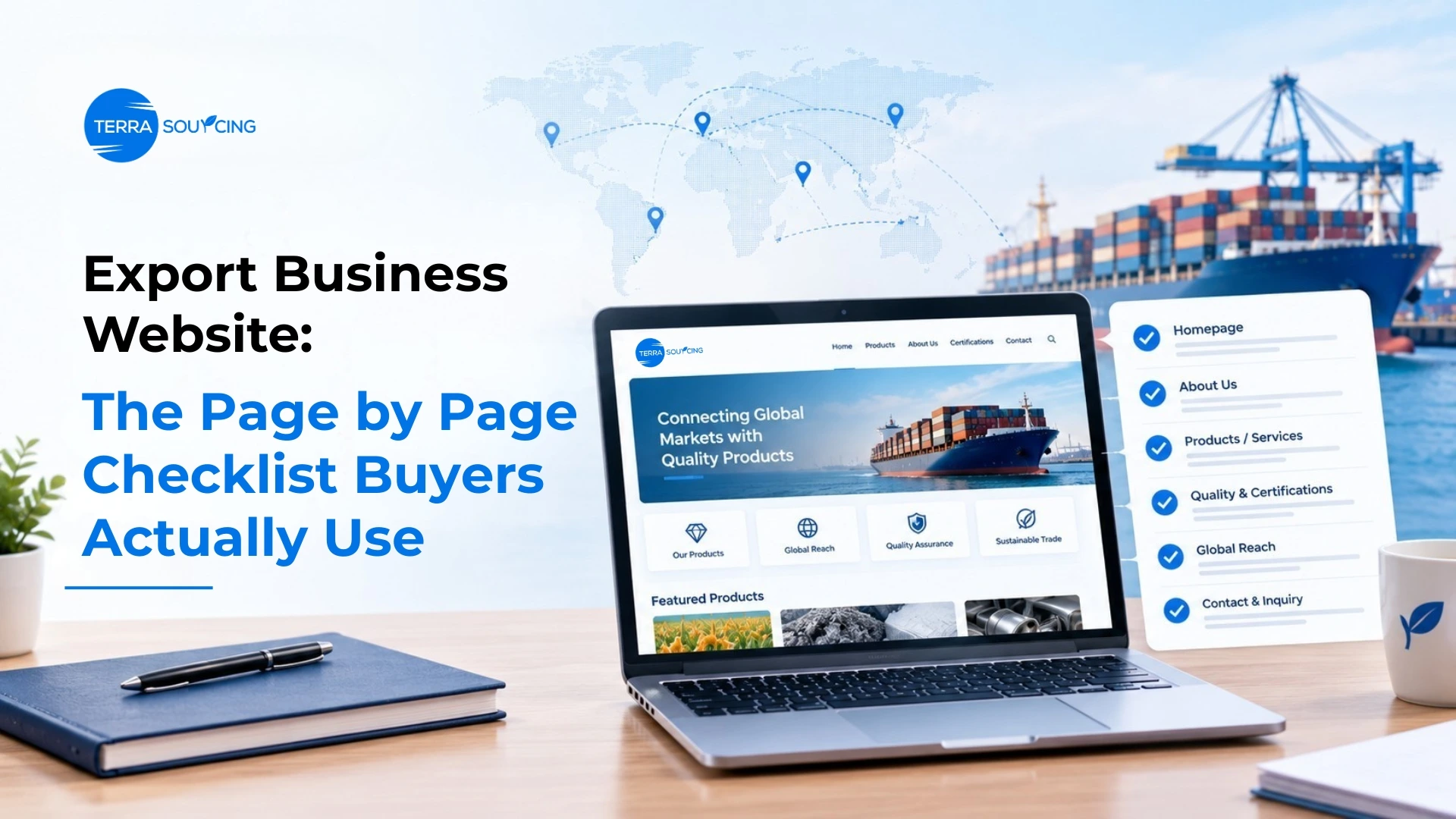
There is a moment, somewhere between the fourth and fifth cold email of a buyer's morning, when they open a supplier website in a new tab and give it the kind of attention you give a parking sign. Twenty seconds. Maybe forty if something holds them. An export business website is built to survive that moment, and most are not, because most were briefed as brochures.
The brochure instinct is understandable. You want the site to say who you are, show the factory, convey scale and seriousness. So the homepage gets a slider of warehouse photographs, a paragraph about commitment to quality, and a tab called Our Vision. All of it is true. None of it is what the buyer in that tab is trying to find out.
They are doing due diligence, compressed into forty seconds. Is this a real company. Do they make the thing I need, in the grade I need. Can I tell what it would cost me to find out more. And is there a human being here.
This export website checklist is built for a site that answers those four questions on every page a buyer might land on. It covers the six pages that matter, what belongs on each, the technical minimum, the content blocks most exporter sites are missing, what to leave off, and a two week sequence for fixing a site you already have. If you want the scored version of where your current site stands, the free export marketing audit does that. This is the fix list it points to.
What an export business website actually needs to do
An export business website has one job: to let a serious foreign buyer complete their initial due diligence on you without having to contact you first, and to make contacting you easy once they have decided to.
Read that twice, because the first half contradicts how most exporter sites are built. The common design puts the valuable information behind an enquiry form, on the theory that this captures leads. It does the opposite. The buyer comparing four suppliers at 9am uses the three who published their specifications and skips the one demanding a form. You did not capture a lead. You removed yourself from the shortlist, silently, and you will never know it happened.
So the operating principle for every decision below is: publish what helps a buyer decide, and make the ask small.
The six pages that matter, and the ones you can skip
| Page | The one job it does | Priority |
|---|---|---|
| Homepage | Says what you make, for whom, and where you ship, in one screen | Build first |
| Product pages, one per product | Carries the specification a buyer needs to shortlist you | Build first |
| Company page | Proves a real, competent, locatable business exists | Build first |
| Certifications and compliance | Settles the regulatory question for your category | Build first |
| Contact page | Makes writing to you easy and signals a response is coming | Build first |
| Resources or downloads | Catalogue, spec sheets, guides. Supports the others | Build second |
| Blog | Earns search traffic over months. Not a launch requirement | Build later |
| Our Vision, Our Values, Chairman's Message | None that a buyer uses | Skip |
| Photo gallery with no captions | None | Skip |
| News page updated twice in four years | Actively harmful. A stale page dates the whole site | Skip or commit |
Five pages. That is a real export business website. Everything else is addition, and most additions dilute. A five page site that answers the four questions beats a twenty page site that buries them.
Page 1: The homepage
The homepage has one screen to work with, on a phone, before the buyer decides whether to scroll. Treat everything below the fold as a bonus.
Above the fold, these four things:
- What you make, in a buyer's words. Not "leading manufacturer and exporter of quality products". Name the category and the specifics: "Manufacturer and exporter of basmati rice, 1121 and 1509, from Haryana." A buyer should be able to disqualify you in three seconds if you are not a fit. That is a feature. It saves you both time.
- Who you serve and where you ship. Markets already served, named. "Shipping to the UAE, Netherlands and Vietnam since 2016" does more work than any adjective.
- One hard credibility fact. Year established, factory capacity, certification, or an export volume you are willing to state. One, placed high, not six scattered.
- One clear action. View products, request a quotation, download the catalogue. One primary button. Not five.
What should not be on the homepage: an auto playing slider, a popup that appears before the buyer has read anything, a chat widget nobody staffs, stock photographs of handshakes or globes, and a paragraph that begins "In today's competitive global marketplace".
Page 2: Product pages, one per product, not one page for everything
This is where enquiries are won and lost, and it is the single most neglected part of most exporter websites. A single page listing eleven products with a line of description each is not a product page. It is a menu. The buyer needs a page per product, or per clearly defined product family, that stands on its own when landed on directly from a search result or an email link.
Every product page needs this specification block, laid out as a table so it can be scanned and so answer engines can extract it:
| Field | Why a buyer needs it |
|---|---|
| Product name and grade or variety | Shortlisting happens on grade, not on category |
| Technical specification | The parameters your market specifies on, stated in the units they use |
| HS code | Lets the buyer check duty and compliance in their own country without asking you |
| Packing options | Bag, carton, drum, pallet, with weights. Decides their landed cost |
| Minimum order quantity | The single most common reason for an unanswered first email |
| Lead time | From order confirmation to readiness, stated honestly |
| Shelf life or storage, where relevant | Mandatory for food, agri and chemicals |
| Port of loading | Affects freight. Cheap to state, surprisingly often omitted |
| Certifications applying to this product | Scope matters. A plant certification is not a product certification |
| Available documentation | Phytosanitary, certificate of analysis, origin, fumigation, as applicable |
Below the table: three to five photographs of the actual product and its actual packing, a short paragraph on what distinguishes your version, and a contact action that names a person.
Two rules about this block. First, publish the numbers. If your minimum order quantity is one container, say one container. The buyer who cannot meet it was never a customer, and the buyer who can has just moved you up their list. Second, state the specification in the units your market uses, and say which standard you are quoting against. A moisture percentage without a test method is a number, not a specification.
If you sell into multiple markets with different requirements, make that explicit on the page rather than averaging it into something vague.
Page 3: The company page
This is the page an export company website most often wastes. It exists to convert an anonymous logo into a locatable business. The checklist is short and almost entirely about specificity.
- Year established, and under which legal entity name
- Factory or processing unit location, stated as a place a buyer could look up, with the address
- Capacity, in units that mean something: tonnes per month, containers per year, production lines
- Markets you already export to, named by country
- Your Importer Exporter Code, issued by DGFT, which costs nothing to display and is checkable
- GST and company registration number, as applicable
- At least one named human being with a role, a photograph and a way to reach them
- Three to six photographs of the actual facility, captioned with what they show
That last point about a named person is the one exporters resist and the one that moves the most. A buyer taking a risk on an unknown supplier is trying to establish that a competent person exists who will still be there in four months. A faceless company page cannot answer that. A founder photograph, a name, a role and a LinkedIn link can, at zero cost.
What to leave off: a company history written as a narrative of struggle and vision, a values list, and the phrase "we believe in building long term relationships", which every one of your competitors also believes in.
Page 4: Certifications and compliance
Buyers in regulated categories check this page before they check your price. The failure mode here is not absence, it is vagueness.
- Name each certification precisely: the standard, the version, the issuing body, the certificate number and the expiry date
- State the scope. A certification covering your processing unit is not the same as one covering the specific product you are promoting, and experienced buyers know the difference
- Make the certificate itself viewable. A scanned PDF is enough. A logo without a certificate reads as decoration
- List the market specific registrations that apply to your category and destinations, such as importer or facility registrations your buyers will ask about
- State which trade terms you work on, naming the edition: Incoterms 2020, which is the current ICC edition as noted at the top of this post
- State your usual payment terms, or at least the range you work within
The cost of vagueness here is specific. A buyer who cannot confirm your certification scope from your website either writes to ask, which adds a week, or moves on, which adds nothing. Most move on.
Page 5: The contact page
The contact page is the highest intent page on an export business website and usually the least considered.
- A working email address, visible as text, not only inside a form
- A phone number and a WhatsApp number, both with the country code
- Your time zone and working hours, so a buyer knows when an answer is realistic
- The name and role of the person who receives enquiries
- A postal address, which is a credibility signal as much as a logistics one
- A short form, if you want one, with three fields at most: name, email, message. Every additional field costs you enquiries
- A LinkedIn link for the company and for the person named
Then test the form. We find forms that submit successfully, display a thank you message and deliver nothing at all, sometimes for years. Submit a test enquiry from an outside email address, confirm it arrives, and repeat that test after every site change. This takes four minutes and is the highest return four minutes in this entire checklist.
One more thing belongs here: what happens next. A line saying "we reply to all enquiries within one working day" sets an expectation. Only write it if it is true, and if it is true, it is a genuine differentiator.
Page 6: Resources and downloads
Optional, and worth building second rather than first.
- Your catalogue as a PDF, with the file size shown and the version dated
- Individual product specification sheets
- Certificates, if not already on the compliance page
- Any buyer facing guidance you have written, which also earns search traffic over time
Make downloads ungated. The catalogue behind a form is the same mistake as the gated specification, in a different outfit. If you want to capture the visitor, offer something worth exchanging an email for and let the catalogue go.
The technical minimum
None of this is optional for a website for export business, and none of it requires a large budget.
| Item | The standard to hit | How to check |
|---|---|---|
| Your own domain | A domain you own, registered to your company, renewed for several years | Your registrar account |
| Email on your own domain | name@yourcompany.com, never a free mailbox for business correspondence | Your email settings |
| HTTPS | A valid certificate, no browser warning | Open the site and look at the address bar |
| Mobile layout | Readable and usable on a phone without pinching | Open it on your own phone, not a desktop preview |
| Load speed | Fast enough that an impatient buyer stays | Google PageSpeed Insights, free |
| Indexing | Every product page findable in search | Google Search Console, free |
| Analytics | Something that tells you which pages are visited | Any analytics tool, installed before launch |
| Contact form delivery | Tested from an outside address | Send a test enquiry |
| Backups | Automatic, and restorable | Ask whoever hosts it, in writing |
The free mailbox point deserves a sentence of its own. A business email on a free consumer domain is read by experienced importers as a signal of either a very small operation or an intermediary, and sometimes of something worse. The fix costs very little per user per month and it is the cheapest credibility purchase available to an exporter.
The eight content blocks most exporter websites are missing
These appear on almost no Indian exporter websites and are almost always the reason a buyer asks a question instead of placing an enquiry.
| Missing block | Where it goes | What it prevents |
|---|---|---|
| Minimum order quantity | Every product page | The most common silent disqualification |
| Lead time | Every product page | Buyers with a shipping window cannot plan around you |
| Packing specification with weights | Every product page | Stops the buyer calculating landed cost |
| Port of loading | Product pages or company page | Freight estimates are impossible without it |
| HS code | Every product page | Buyer cannot check duty in their own country |
| Named contact person | Contact and company pages | Buyer cannot judge whether anyone is accountable |
| Time zone and working hours | Contact page and footer | Buyer assumes you are slow when you are asleep |
| Certification scope, not just the logo | Compliance page | Buyer cannot tell whether the certificate covers their product |
Work through this table against your current site before you consider anything about design. It is the highest value page in any export website checklist. Every row is content, not layout, and every row can be fixed this week by someone who knows the answers. That is usually you, not your developer.
What to leave off your export business website
Some things cost you credibility rather than adding it. They appear in exporter website design often enough to be worth naming.
Unverifiable superlatives. "Leading exporter", "world class quality", "one of the largest". A buyer cannot check any of these, so they discount them, and the discount spreads to the claims you can support.
Testimonials with no name, company or country. An unattributed quote reads as invented, even when it is real. Either get permission to name a buyer, or publish an anonymised reference with the country and sector stated, or publish nothing.
Stock photography of the product. If the photograph on your rice page also appears on four competitor sites, you have told the buyer you may not handle the goods.
Logos of companies you have not supplied. This is more common than it should be, and when a buyer recognises one and asks, the conversation is over.
Certification logos without certificates. See above.
A copyright line reading 2019. It dates the entire site in one glance. Make it automatic.
Flags of every country you would like to sell to. Buyers read these as aspiration, not evidence.
Writing for a buyer who is not Indian
Small language choices carry disproportionate weight because they are read as competence signals.
Write plainly. "Please share your requirement" rather than "kindly do the needful". The phrasing common in Indian business English is not wrong, but it is unfamiliar to many buyers and reads as a template.
State units in both systems where your market differs: metric tonnes with the equivalent, dimensions in centimetres and inches where relevant.
Write dates unambiguously. 05-09-2026 means two different months depending on who reads it. Write 5 September 2026.
Name the currency explicitly. Not "price on request" alone, and never a bare number.
Name ports and cities in the form a buyer will recognise, and give the country: Mundra, Gujarat, India.
Keep sentences short. Your buyer may be reading in their third language.
Trust signals that work and ones that do not
| Works | Does not work |
|---|---|
| A named founder with a photograph and a LinkedIn link | A faceless "About Us" paragraph |
| A certificate you can open and read | A certification logo in the footer |
| Named export markets and years served | "Serving clients globally since many years" |
| Real photographs of your facility and packing | Stock images of ports and containers |
| A specification table with numbers in it | "Best quality as per buyer requirement" |
| An anonymised buyer reference with country and sector | An unattributed five star quote |
| A stated response time you actually meet | A chat widget nobody answers |
Three decisions to settle before you build
These three take an hour and save months.
Who owns the domain and the hosting account. It must be your company, in your own registrar and hosting accounts, with your email on the recovery. Exporters routinely discover years later that the agency owns the domain. Settle this in writing before any work starts.
What platform, and who maintains it. The honest criterion is not which platform is best, it is who will update a price or add a product in eighteen months. If that person is you and you are not technical, choose something you can edit yourself. If it is an agency, agree the cost of a small change before you sign, because that is the cost you will actually pay repeatedly.
What the site must do, written down. One page: the five pages, the products, the specification fields, the contact details. Hand that to whoever builds it. Most disappointing website projects are briefing failures, not building failures.
On cost, we are not going to publish a price range for exporter website design, because quoted figures vary enormously by scope, location and platform, and a number here would mislead more than it helps. What we will say is that the content work in this checklist, which is most of the value, costs nothing except your attention, and it is worth doing before you commission anything.
How to fix an existing site in two weeks
If you already have a website, do not rebuild it. Rebuilds take three months and stall. Work this sequence instead.
| Days | What to do |
|---|---|
| Day 1 | Test the contact form from an outside address. Fix the email, phone country code and footer year. Open your own site on a phone and note what is unreadable |
| Days 2 to 3 | Write the specification block for your two priority products. The fields are in the table above. Get the real numbers, including minimum order quantity and lead time |
| Days 4 to 5 | Publish those two product pages properly, one page each, with real photographs of product and packing |
| Day 6 | Rewrite the homepage top screen: what you make, who you serve, one credibility fact, one action |
| Days 7 to 8 | Rewrite the company page with specifics: year, location, capacity, markets, IEC, a named person with a photograph |
| Day 9 | Fix the certifications page: exact names, scopes, issuing bodies, viewable certificates, correct Incoterms edition |
| Day 10 | Fix the contact page: visible email, country codes, time zone, named person, three field form |
| Days 11 to 12 | Technical pass: HTTPS, speed check in PageSpeed Insights, submit the site in Search Console, confirm product pages are indexed |
| Day 13 | Run the six tests below |
| Day 14 | Fix whatever the tests surfaced. Then resume outreach |
Two products, not eleven. The remaining product pages follow the template you have just built, at whatever pace you can sustain.
Six tests before you call it done
The phone test. Open your site on your own phone over mobile data, not office wifi. If you would not wait for it, neither will a buyer.
The stranger test. Send the link to someone who does not know your business and ask them to tell you, in one sentence, what you sell and to whom. If they cannot, the homepage has failed.
The form test. Submit an enquiry from an email address outside your company. Confirm it arrives, in the inbox, not in spam, to a person who is watching.
The specification test. Open a product page and try to answer this as a buyer would: grade, packing, minimum order quantity, lead time, port, HS code. Any gap is an enquiry you will not receive.
The search test. Search your exact company name. Does your own site come first, and does the description under it make sense. Then search one product category plus a market and see whether you appear at all.
The cold start test. Open your site in a private browser window, from a product page rather than the homepage, as a buyer clicking an email link would. Does that page stand alone, and can they reach you from it.
What to do once the site is right
A good export business website does not produce enquiries by itself. It stops you losing the ones your outreach already earns. Once the checklist is clear, the next constraint is traffic and follow up, and that is a different problem with different tools: the 5 touch outreach system for cadence, the export inquiry email templates for the replies, and finding buyers on LinkedIn for the profile that gets read alongside your site.
If you would rather know which items on this list your current site is actually missing, scored and prioritised, that is what the free export marketing audit does. This checklist is the fix list. The audit tells you which three lines to start with.