Every exporter has a folder of leads they are not sure about. An inquiry from a portal that sounds serious. A purchased list of "importers" in Dubai. A LinkedIn contact who wants samples this week. The question is always the same: is this buyer real, and is it worth my time, my samples and my courier money?
Export lead verification answers that question before you spend anything. This article explains exactly how Terra Sourcing's 4-level lead verification process works — what each level checks, which sources we use, how a lead passes or fails, and what you receive at the end — and then walks one sample lead through all four levels so you can see the method rather than take it on trust. If you read our article on why Indian exporters can't find genuine buyers, this is the "how" behind the fix.
What is export lead verification?
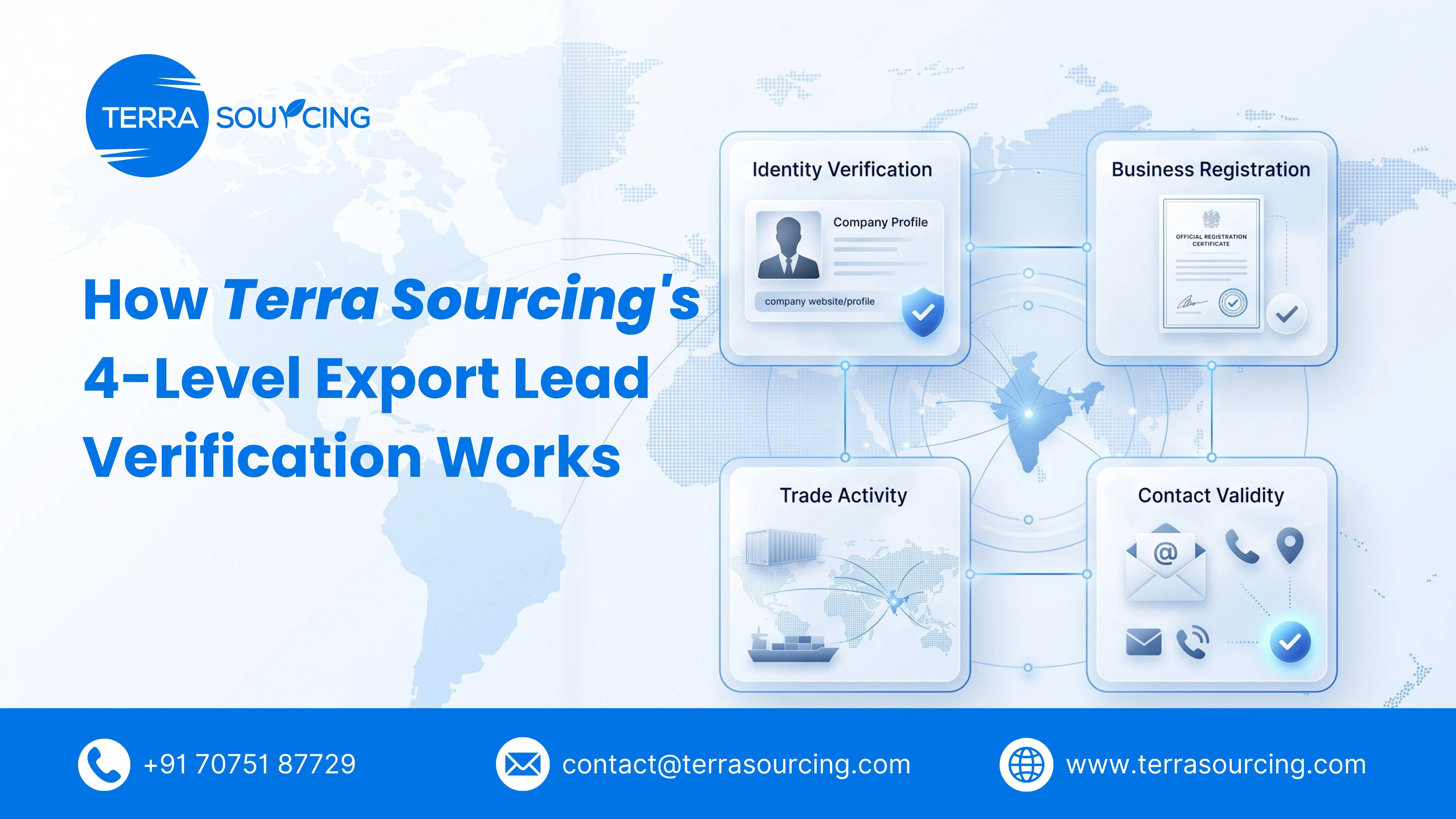
Export lead verification is the process of confirming that a prospective buyer is a real, registered business that actually imports your product category, is run by an identifiable person, and can be reached on confirmed contact details — before you quote, send samples or negotiate. Terra Sourcing runs this as a 4-level check: identity, business registration, trade activity and contact validity, with compliance and fraud screening built in. A lead that passes all four is marked verified; a lead that fails any one is marked not verified, with the reason.
The important word is before. Verification that happens after the sample has been couriered or the "registration fee" has been paid is not verification; it is damage assessment.
Why do exporters need buyer verification before outreach?
Because the cost of an unverified lead is paid in samples, courier charges, advance fees to fake agents and — most expensively — weeks of attention spent on contacts that were never going to buy. Buyer verification for exporters moves that cost to the front, where it is small, instead of the back, where it is large.
Four situations make this concrete:
- Portal inquiries. A B2B portal passes you the inquiry, not the buyer's background. The same inquiry goes to many sellers, and nobody has checked who sent it.
- Purchased lists. A list tells you a company name and an email address. It does not tell you whether the company still exists, still imports, or ever imported your product.
- Sample requests. Samples plus international courier are often the first real money an exporter spends on a lead. Sending them to an unverified buyer is the most common small loss we see.
- Advance-fee approaches. Fake buyers and fake agents ask for registration, inspection or "customs clearance" fees before any order. Verification catches these at Level 1 or Level 2, before a rupee moves.
Verification also protects something less visible: your reputation. An exporter who chases every inquiry looks desperate to genuine buyers; an exporter who qualifies leads and responds to the right ones looks like a supplier worth dealing with.
What are the four levels of Terra Sourcing's lead verification process?
The four levels answer four questions in order: Does this company and person exist and match (identity)? Is the company a registered, active legal entity in its country (business registration)? Does it actually import this product category (trade activity)? Can it be reached on confirmed business contact details, and is it clear of compliance and fraud flags (contact validity)? Each level has its own sources and its own pass/fail rule, and a lead must pass all four.
| Level | Question it answers | What we check | Typical sources | Pass rule |
|---|---|---|---|---|
| 1. Identity | Do the company and the contact exist, and do they match? | Company web presence; named contact's role at that company; email domain matches company domain; consistency across channels | Company website, LinkedIn, trade directories, WHOIS domain records, search | Company and person found independently of the inquiry; details consistent; mismatches explained |
| 2 · Business registration | Is it a registered, active legal entity? | Legal name, registration or licence number, status, licensed activity, registered address | Official registries: UAE National Economic Register and emirate/free-zone directories, Companies House (UK), US Secretary of State searches, EU VIES, ACRA (Singapore), Saudi Ministry of Commerce | Active registration found under the name given; licensed activity consistent with importing your product |
| 3 · Trade activity | Does it actually import this product category? | Import or shipment records for the relevant HS codes; sourcing countries; recency and pattern of imports; where no shipment data exists, proxies such as import licences, industry membership, trade-fair participation and references | Import/shipment data providers and public customs records where available; ITC Trade Map and UN Comtrade for market-level context; industry bodies | Evidence of importing the category (or a credible, checkable proxy) within a recent period |
| 4 · Contact validity | Can you actually reach them — safely? | Phone connects to the business; email deliverable on the company domain; address matches registration; screening against international sanctions lists and known fraud patterns | Direct call-back to registry or website numbers, email domain checks, address match, sanctions and fraud screening | All contact channels confirmed; no compliance or fraud flags |
The order matters. Identity first, because a lead that fails identity rarely deserves the registry search. Registration second, because a company that does not legally exist cannot be a buyer. Trade activity third, because a real company that has never imported your product is not a buyer for you. Contact validity last, because a buyer you cannot reach — or cannot safely deal with — is not a lead however real it is.
Level 1 — Identity: do the company and the person exist and match?
This level asks whether the company and the contact exist independently of the message you received. Anyone can type a company name into an email. A genuine buyer leaves a trail that was not created for you: a website that predates the inquiry, a LinkedIn page with staff, a listing in a trade directory, a named purchasing manager whose profile says they work there.
What we check, in practice:
- Company footprint. Website, LinkedIn company page, directory listings, news or trade-fair mentions. A company with no footprint at all is not automatically fake — some small traders are offline — but it cannot pass Level 1 without further evidence.
- Person-to-company match. The named contact appears on the company's site or LinkedIn in a role that plausibly handles purchasing. A "procurement director" who exists nowhere except your inbox is a flag.
- Email-domain match. The email domain matches the company's website domain. A free webmail address is common among small importers and is treated as a flag, not a fail — the lead is asked for a company-domain address or another proof of identity before it can pass.
How long does export lead verification take, and what does it cost?
Your first 10 leads are verified free, with results within 48 hours — no card needed. After that, you can verify further leads on a pay-per-lead basis on the platform, get verification included in the Consultation (30 verified buyer leads as part of the engagement), or use the platform's paid plans where verification is built into buyer discovery.
| Option | What is verified | Turnaround | Cost |
|---|---|---|---|
| Free Verification of 10 Leads | 10 buyer leads you already have, at all four levels | Within 48 hours | Free |
| Pay-per-lead verification on the platform | Any number of your own leads | Typically within 48 hours per batch | Per lead — current rates on the pricing page |
| Consultation (3–6 months) | 30 verified buyer leads we find for you in one target market, plus verification of leads you bring | Across the engagement, with a weekly call | Included in the consultation fee |
| AI Lead Generation Platform (paid plans) | Buyers discovered in the platform, verified before they reach your list | Continuous | Plan pricing announced at launch |
Which one fits depends on where your leads come from. If you already have inquiries and lists, start with the free ten. If you have a product and no leads, the Consultation finds and verifies them for you. If you want to run your own pipeline, the platform does discovery and verification together.
Can you run this lead verification process yourself?
Yes. Follow the free 4-level checklist with the tools for each step. If you want to learn how to verify export leads yourself, the full manual version is in our 4-level checklist for verifying a foreign buyer; the short form is:
- Find the company and the person independently of the inquiry; match the email domain.
- Look the company up in the official register of its country; match the name and the activity.
- Look for evidence it imports your category — shipment data where available, credible proxies where not.
- Call back on the registry or website number, confirm the email and address, screen for sanctions and scam patterns.
Doing this well takes time the first few times, and trade-activity data is the step most exporters cannot access cheaply on their own. That is the part a service earns its fee on. For a handful of leads a month, do it yourself; for a list of fifty, or before a trade fair, send them to be verified and spend your time on the conversations.
What export lead verification cannot do
We would rather say this plainly than have you learn it later:
- Verified does not mean guaranteed. A verified buyer is real, registered, active in your category and reachable. It can still negotiate hard, go quiet or choose another supplier. Verification qualifies the lead; it does not close it.
- Verified does not replace payment protection. Start every new relationship on an advance or a letter of credit, and consider ECGC export credit insurance on early orders. Verification tells you the counterparty exists; payment terms protect you if circumstances change.
- Evidence has limits. New importers have no history; some markets publish no shipment data; registries differ in what they show. We report what can be confirmed and flag what cannot, instead of guessing.
- It checks buyers, not your offer. If your price, certification or MOQ do not fit the market, verified buyers will still say no. That is a market-research question — and why the Consultation starts with a market research report rather than a lead list.
Who should use a lead verification service — and when
- Exporters with portal inquiries (IndiaMART, TradeIndia, Alibaba): verify before replying in detail, and certainly before samples.
- Exporters who bought or inherited a list: verify a sample of the list first; if most of it fails, you have saved weeks.
- Exporters about to send samples or travel to meet a buyer: verify the specific buyer at all four levels first.
- First-time exporters in a new market: verify every early lead; your judgement of "what a genuine buyer looks like" in that market is not yet calibrated.
- Exporters approached with urgency or fees: verify before any payment, always.
Mistakes exporters make with verification
- Treating a registration number on a letterhead as verification — it must be checked in the register, and the name and activity must match.
- Calling the number in the inquiry instead of the number on the register or website.
- Accepting a "verified buyer" label from a list seller without knowing what was checked; our post on what "verified" should mean before you pay sets the standard.
- Skipping trade activity because the company is "obviously real".
- Sending samples "to build goodwill" before Level 4 is complete.
- Dropping payment protection once a buyer is verified.
Export lead verification is not a formality and not a black box. It is four questions — real? registered? importing your category? reachable and safe? — answered from sources that do not depend on the buyer's word, in a fixed order, with a clear result and the reason behind it. Run that way, it turns a folder of uncertain inquiries into two short lists: buyers worth your time this week, and contacts to drop without regret.
You have seen the method and one lead walked through it. The next step is to see it on your own data: send us 10 buyer leads you already have and receive a verified or not-verified result for each, with reasons, within 48 hours — free.